sábado, 22 de noviembre de 2014

V for Vendetta in our Current Society

As we have discussed in class, the letter V in V for Vendetta has several meanings, such as the number five, the sign of victory Winston Churchill used to do, among others. This got me thinking about the many other meanings this letter may have, which is why I looked for the following five meanings within the graphic novel.
  1. 1   “the novel revolves around five (V) key “transformations” – the creation of V himself, the transformation of Evey from victim into active figure, the descent and reawakening of Finch, the shift of Mrs Almond from “party wife” (docile, subservient fascist matron) to “fallen woman”/assassin, and the wider social awakening through rebellion” (Chen 4). It can also stand for the room in which V was in at Larkhill (room V).
  2.      This letter can also represent all the people who were victims of torture by oppressors in the Larkhill concentration camp.
  3.      V can mean villain as V introduced himself for the first time to Evey.
  4.      V within a circle resembles the anarchy symbol upside down. And in the novel, it becomes a “visual metaphor for the public’s descent into anarchy.” (Muise)
  5.      V stands for various, for the many meanings it has to it both literally and figuratively.

         While I was looking for information about the meaning of V within the book, I realized that what I was really interested in was not in the actual meaning of the letter, but in the meaning that people around the world have given to V’s actions and quest against the system, and the impact these interpretations have caused.

As a starting point, I believe it is of paramount importance to keep in mind that out of the five meanings of the letter V in the novel I just mentioned, most of the real-life manifestations influenced by V are usually based on the third and/or second ones i.e. people may often feel victims (oppressed and violated) of the government or other organizations.

The main representative of V’s ideals is Anonymous, a network of activists who feel oppressed by different entities or who feel the need of a radical change of a particular aspect that affects their lives and those of the rest of the world population. Although it exists since 2003, its proponents have increased exponentially since the release of V for Vendetta (movie).
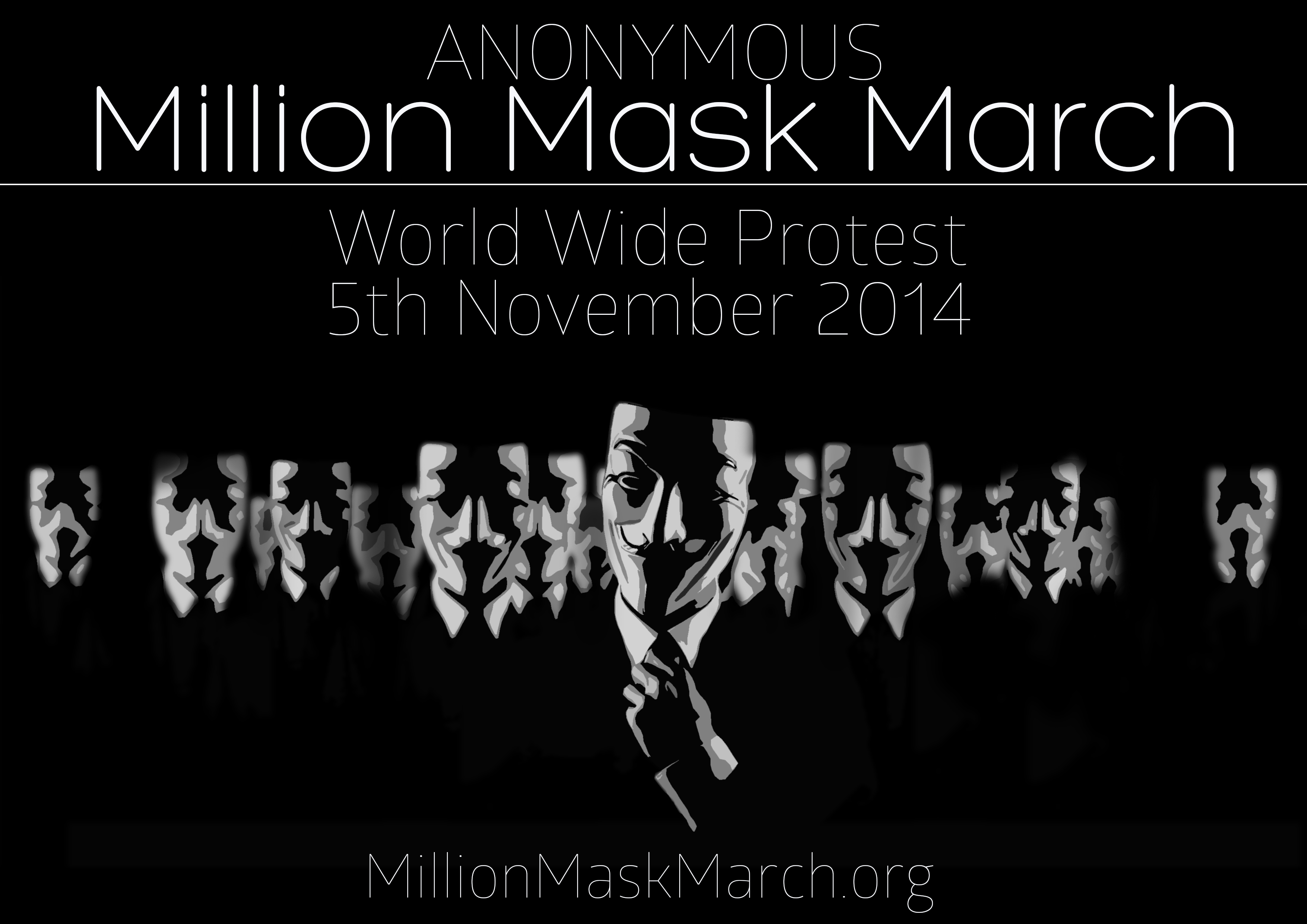


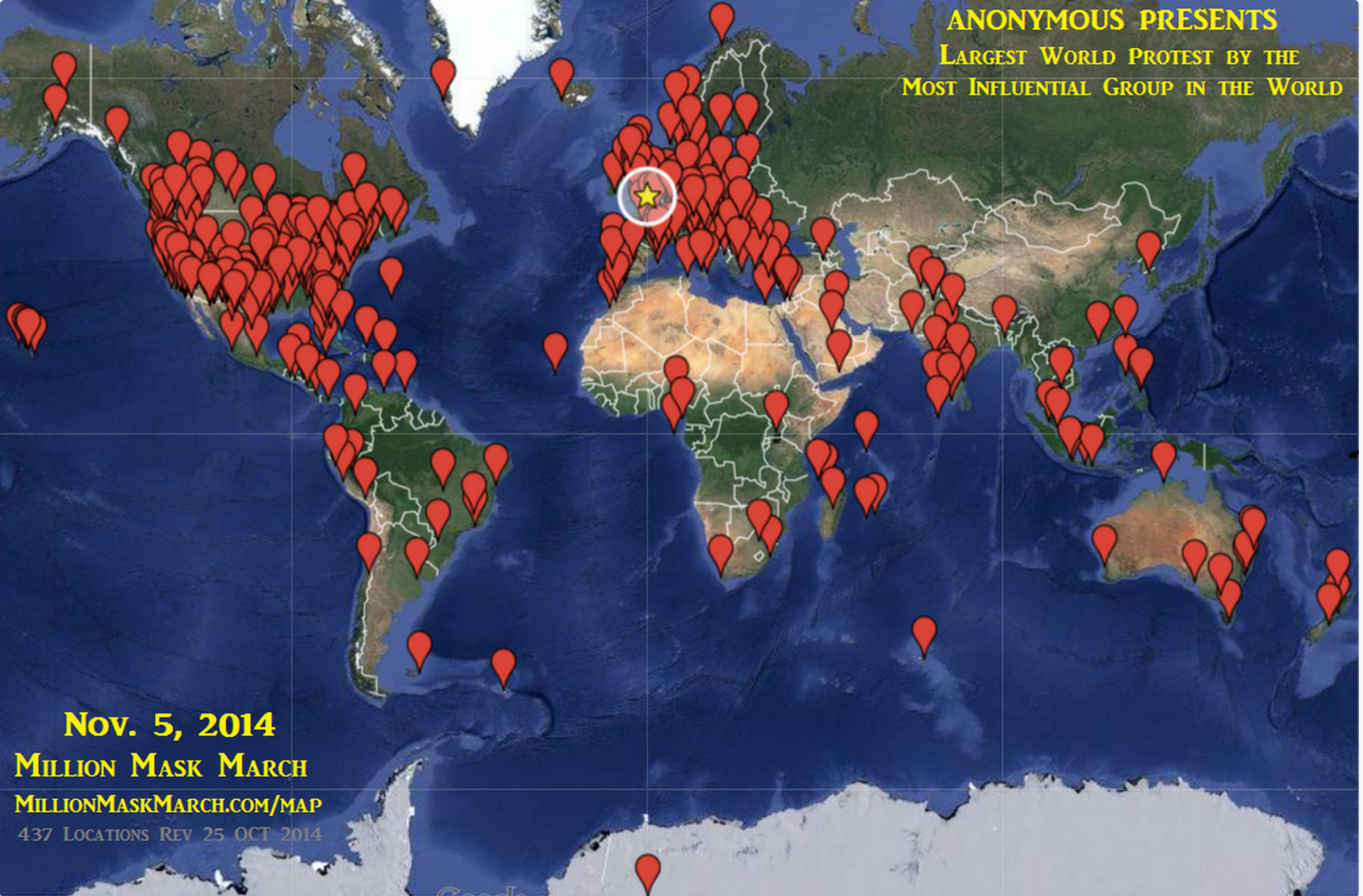
Anonymous has summoned those who support their cause in several opportunities, and this movement appears to have gained strength with time. The manifestation that represents Anonymous the best is the MMM (Million Mask March), which is held every year in the fifth of November world widely, being the 2014 version the most important and biggest one. This version of the MMM was intended to show the governments the power that people have and to share ideas regarding the “enemies of the human,” who are those that attempt to control aspects of people’s lives that shall not be controlled (such as Google and Facebook’s private information violations, and corrupt politicians who have made it just to be unjust) as well as to distribute information regarding the imprisonment of Julian Assange (founder and editor of WikiLeaks). The participation was tremendous as manifestations were seen in most of the world, although focused on the United States and Europe. 


All in all, I came to the conclusion that each one of us will make from V, the letter, and V, the character what we think suits us better. Each one of us have our own beliefs and ideologies and V for Vendetta teaches us that we always has and will have something to fight for, regardless of what we are confronting, as annonymous has proved countless times through their cyber boycotts.

What does V mean to you? What will you fight for? Or against?

I also invite you to read these two pieces of news to comment about:


References:

Chen, Peter. "Examining V for Vendetta - Film, Graphic, Novel, and Interpretation." 28 May 2006. Academia.edu. 21 November 2014. <https://www.academia.edu/1397120/Examining_V_for_Vendetta_Film_Graphic_Novel_and_Interpretation>.
Muise, Chris. Hyperink. n.d. 21 November 2014. <http://www.hyperink.com/Major-Themes-And-Symbols-Innbspldquov-For-Vendettardquo-By-Alan-Moore-b260a9>.


1984 vs V for Vendetta


George Orwell and Alan Moore are well-known writers who were famous in very different times. Orwell in the 1940's and Moore from the 1980's to present times. This difference in time affected their work, and especially the ones that are relevant for the purpose of this post. 
   

On the one hand, 1984 was written after the horrors of World War II, when the world was starting to get ready for the 'Cold War'. Considering this, we can understand the references to totalitarian governments, and to the strange distribution of the world in the novel. In addition, Orwell presents a dystopian society, in which the system or the government has complete control, and the proles (common people) are manipulated without much trouble, living in constant oppression without even noticing. The hero of the novel is Winston Smith, who works for the ruling party,  and is defenseless against the power of the almighty government. The major themes that surround the hero are vulnerability and passivity. At some point in the novel, he realizes that there is nothing that can be done to change their fate, to stop the party or the Big Brother. Therefore, he also realizes that they are all trapped, without any possible exit, and that all the faith that he had in the proles was meaningless because no matter what they do the Big Brother will always be watching, and the party will always have total control of everything. 


On the other hand, V for Vendetta was first published near to the end of 'Cold war', living in a much freer social context, one in which freedom and other ideals were starting to become a reality for the people, after everything the world has been through, trying to leave behind the horrible memories that War produced, with a much empowered society that was not going to accept everything that their leaders say. Here is where Moore introduces a dystopian society, again, with a firm leadership headed by a High Chancellor and its main party, but with a complete opposite hero. The hero, V, is a strong, determined and aggressive character who has decided that people should not accept the government's oppression anymore. To achieve this, he uses the force of the people, along with chaos, anarchy and a lot of gunpowder. There is no place to doubt or passivity here, even though at the beginning of the story he is fighting alone, people take their position beside him as well, encouraged by the hero's image. The ideal that the power should be for the people is emphasized. People rising against the government, that is the right answer, the only possible response to get the power back, and to ensure a future of freedom. 


Direct or Indirect violence?

Through this post I will be talking about the graphic novel by Allan Moore in which the main character “V” fights with the intention to give the power back to the people (Billias, 2010) not as in the case of Orwell´s novel who warned us about the dangers of totalitarian regimes in which their heroes were only victims of the system, not terrorists who actively fought against it (Billias, 2010) as in the case of V for Vendetta. Additionally, from my perspective I will be analyzing some points that I found really important to highlight.

To start with, one of  the points that have called my attention has to do with the inner power that the main character has.  Allan Moore through the character V shows that the most relevant thing in life are beliefs, which give us clarity, therefore when you are completely clear with your convictions  nothing can defeat you. V strongly believes that he needs to change the situation of his society and he does everything in order to get it even if the ways are not the best ones . From my point of view, those beliefs and convictions make him strong, gives him the power for the sake of achieving the goal. This made me think in how the most important social movements around the world and even along our country are persistent in time and even if they know that it could be impossible to get something, they do whatever it is possible to transform those unreasonable situations that they believe are not fair.


Furthermore, as we know governments usually modify the reality and show us that terrorists are our enemies… ok.. We can agree that the style of Vendetta of fighting is not the best. But, I wonder myself if he is the terrorist or the government? What is worst to fight against the system or that this damaged system act above people with all the injustices that they exerted on them? . For instance, encapuchados are they the terrorists? Have we asked ourselves why they do it?  Maybe if we think about it, they do those things because they are damaged by this system that only allow someone to pop up. However, television and authorities argued  that they are the ones who are the villainous of this story.

V for Vendetta uses violent methods, but  in our daily life we are surrounded by indirectly violence. Let me asked you; is it not violence that people do not have to eat? Or that some people cannot afford their education? The thing is that the system show us this as part of our reality.. Is just because…

All things considered,  it is worth mentioning that this graphic novel has been one of the most controversial, for instance it is feasible to see in some demonstrations how people used the same mask as  Vendetta with the intention to show his/her discontent. Due to the simple reason, that people is  familiar with those issues mentioned in the novel, actually, the author states that  there are  parallels between the dystopia predicted in the story and the world today (Lamont, 2011).

References

Billias, N. (2010). Promoting and Producing Evil . Editions Rodopi .

Lamont, T. (26 de November de 2011). Alan Moore – meet the man behind the protest mask. The Guardian , pág. 14.


1984, Personal reflections


" for whom, it suddenly occurred to him to wonder, was he writing this diary? For the future, for the unborn...  For the first time the magnitude of what he had undertaken came home to him. How could you communicate with the future? It was of its nature impossible. Either the future would resemble the present, in which case it would be different from it, and his predicament would be meaningless." 
                              1984, George Orwell 

Do we write for the future? Do we write to conquer a better world? Or Do we write to unleash ourselves from the power of our thoughts?

1984 is largely based on Wiston's personal reflections on his existence and the world in which he lives. Thoughtcrime is such a difficult crime to discover, so easy to hide, but once Wiston starts writing, he makes this crime tangible.
Even though, writing was a prove of his crime, it gave Wiston freedom. Miriam Joy wrote: 

"Putting things into word makes them easy to bear. Because it means you've beaten them. If they're words on paper, they're just like the stories you write. Which means they can't be real. I mean, stories are just things you think up"

What she says is that we write stories to have control over them, and in the same way, we write our feelings and reflections down as a way to have control over them. At least, we can control what we think. At the same time, as we discussed in class, there is nothing more real than what is written. Of what can I be sure if not of the words in a paper? Simple stories and thoughts, rebellions and plans are not real until they are put on paper.

As in 1984, we are constantly been slaved by society, routines, social media, technology, political parties and our own expectations or hopes or a better life. We find different outlets and ways of escaping and feeling control. For some it might be a public manifestation, or a social media unplug. For Wistonit was his diary and I believe that THAT has a. Strong connection with our reality: Facebook, Twitter and blogs have become a constant outlet for our feelings of discontentment, frustration and uncondformism. We live constantly slaved by our DEMOCRATIC SOCIETY OF ONES, where the individual is the most important and as Wiston, we constantly searching for someone that shares our same line of thought always uncertain of who really believes or not. We write with the hope of finding a confident in crime.

" writing is a form of therapy; sometimes I wonder how all those who do not write, compose or paint can manage to scape the madness, melancholy, the madness and fear which is inherent in a human situation"                               Graham Greene

 Do we write to rebel against something? As a reaction or response? Or we write to scape from the power of thoughts and ideas? When something occurs, when we get a brilliant idea, when we discover a secret, our mind does not rest until we utter it ( writing a diary, writing your bff, writing to all your Facebook friends) there is a need for a confident and writing frees us, keeping thought from controlling us and managing to control them on the paper. Words are powerful, but writing them down empowers us. OR AT LEAST THAT IS HOW WE FEEL.

1984, part 1, chapter 7 , page 7
Miriam Joy, October 2013, www.miriamjoywrites.com
Graham Greene, Ways of escape, www.goodreads.com

Dare or not to dare?

Dare or not to dare?


Dare or not to dare?
V v/s Winston Smith. Some might say that there is no way of comparing them. The first one despises the system and wants his vendetta, the second one also despises the system, however, he works in it (Ministry of Truth) and he doesn’t want any vendetta, he gets to question his current situation as a citizen of Oceania but he never actually acts towards fixing what he thinks is wrong. Although it is difficult for Winston to do something about his current situation because he actually works for “Big Brother” and they are all under “constant surveillance”, it is also difficult for V, since all the characters that he is looking for have a “high” role in society.

Let’s start with Winston. He strongly disagrees with the oppression that Big Brother through the different ministries has on people. “DOWN WITH THE BIG BROTHER” he writes in his diary, knowing the consequences of it if he was to be caught by the Thoughtpolice. His ideals are reflected somehow upon his actions. He is interested in knowing more about the Brotherhood and he even involves with O’brien, a man who deceived him making him think that he was a member of this Brotherhood but later turned out to be a loyal member of the Inner Party. Added to this, he rented a room above Mr. Charrington’s shop, who is a member of the Thoughtpolice. Where I want to finally get is when Winston is tortured and is forced to face his “worst nightmares” in room 101. “‘You asked me once’, said O’brien ‘what was room 101. I told you that you knew the answer already. Everyone knows it. The thing that is in room 101 is the worst thing in the world.” (Orwell). Once Winston leaves room 101, after being tortured in all sorts of ways, he finally loses everything human inside him. He becomes part of the mass, his critical thinking or repudiation to injustice had been left behind due to his suffering. Big Brother had won. “But it was alright, everything was alright, the struggle was finished. He had won the victory over himself. He loved Big Brother” (Orwell). What can a man do against this kind of oppression? From my point of view, not much.

As for V, we don’t know much about his identity but the kind of tortures he had to endure are well described. His torture was the thing that unchained his thirst for justice, unlike Winston, his torture made him sit quietly and follow the system without question. While V seeks vengeance upon those who tortured him back at Larkhill, he also seeks to awaken people in London, make them realize the apathetic life they live. For that, symbolically V blows public buildings, so as to remark the repudiation towards the established and to cause a reaction on regular people. For me, this is daring. This can be labeled as following your ideals. V doesn’t care about dying, as long as he fulfills his purpose. He knows that his work will transcend and will be set as maybe an example to follow. This is why we don’t care about V’s true identity. All we care about in the end is his ideas.


To sum up, at least for me, the big difference lies in the fact of daring or not daring. We might keep our own ideals even in a context in which fear has taken everything from us, even our thoughts on a better life. People are not important, because we are expendable.What really matters are our ideas, because ideas transcend and are bullet proof.


References


Moore, Alan y David Lloyd. «V for Vendetta.» DC Comics, 1989.
Orwell, George. «1984.» 1949.

Freedom.... is it real??

As we see in the novel 1984, Winston feels trapped in a life that, even if it looks comfortable and free, it really isn't so.
As we see in 1984, daily life is controlled by the Big Brother Party and even though people seem to be happy and free, they actually are not. This was a very controversial plot, as to suggest the government controls our life might seem risky.

However, are we really free today?

The plot of 1984 can be easily related to the famous Terry Gilliam film Brazil, from 1985. In the film, we find Sam Lowry trying to find a woman that appears on his dreams, while living on a bureaucratic consumerist depressive society, not very far from what we live today. Even though the film lacks of the Big Brother Party factor, it does depicts a totalitarian government, similar to Orwell's novel.


So, are we living on a free society or a we trapped in a consumerism roller coaster? We are made to believe we need certain things to be happy, to be better, to make our lives easier. However, all those things makes us more and more prisoners of a system created to make us need more things.

Just like Winston or Mr. Lowry, we need to free ourselves from that system, as much as we can. sometimes, like in Orwell's novel, we feel like Winston, living like soldiers, without any individuality. Media makes us be a part of that mass, that purchases the same things, that goes to the same places, that wear the same clothes, have the same interests, that no longer needs to think about anything. Everything is ready, you just have to live it. Don't think! Don't feel!

Do you think that is possible to have real individuality?
Do you feel free or you think you depend on too many things to be happy?
Is freedom real? Or is it just an utopia?

References:
 
- Orwell, George. Nineteen Eighty-four. London: Penguin Books, 1954.
-  http://www.gradesaver.com/1984/study-guide/themes
- Brazil (1985 film), by terry Gilliam

V, 5, five,cinco, cinque...


What I like the most when reading novels or watching movies are the different symbols since when I realize about them is like everything makes too much sense.
Once I realized that V appeared in the comic as letter, number and as figure, my first thought was: I'm crazy, I need to sleep.
Hopefully, the teacher said something related to that in classes and I looked up for information about "V" as well and I found that my initial thesis was right: Everything in the graphic novel has to do with V! and here is the proof.
                                                                      

 TITLE
To begin with, and what is blatantly obvious, is the title of the graphic novel: V for Vendetta, doble V here. The Italian word Vendetta is defined in English, according to the Oxford dictionary, as “a  blood feud in which the family of a murderer person seeks vengeance on the murderer ”. In Spanish is defined as “Venganza producida por enemistad, especialmente a causa de una muerte o una ofensa”. A lot of “V” don’t you think? Yes, but it is just the beginning. 

 NAMES
From my point of view, there are at least three names which are related to V
- V is the name of the main character in the graphic novel which is Roman numerals is 5
- Evey is composed of: two “E”  which is the fifth letter of the alphabet, one “V”  which is 5 in Roman numerals, and “Y” which is the 25th letter of the alphabet and if you think about it is also 5 squared.
- The woman who dies in the cell next to V at Larkhill is named “Valerie”.


SCENES
There was two moments in which I think:
are you kidding me?
The first one was in Larkhill, where V was locked, he was not in any cell but in the one with the number 5 which, of course, is written as V.
Then in the Creedy-V fight scene, a V is formed by V daggers before he throws them and also by the Creedy's men formation. After that, when V is mortally wounded, he leaves a V shape on the wall with his blood. 


SYMBOLS
Finally, as in any other novel, story or in this case, comic there is something beyond the letter or even the pictures. I selected just three:
First of all, during the explosion of the UK Parliament fireworks forms a V in the sky, with the V symbol being completed by a circular firework.
Also, the date which is named throughout the comic is the November 5th which  is the only month in the Gregorian calendar with the letter V in it. And when the clock appears, it shows the 11:05 which also forms a V.


After all these examples it is almost impossible not to wonder why in the world is so important the "V" as number, letter or whatever within the comic. There might be a lot of answers. I remember that during the last class, the teacher said something related with the hand, the five fingers and the fight sign and also, something about V as a sign for victory.
However, I believe that the "V" importance has to do with the November 5th in 1605 in which Guy Fawkes tried to exploit the UK Parliament in order to stop what was happening in that time just like V wanted to do it in his time for the same reason.
And last but not least, it just came to my mind that the connection presented above explains why V uses not any mask but the Guy Fawkes's. 


Sources:
-

https://baronvonhoopla.wordpress.com/2007/03/04/the-number-5-in-v-for-vendetta/